Vision Correction Near Me | Glasses, Contacts, LASIK & Eye Surgery Options
Consider the amount of money you’ve spent on prescription glasses, sunglasses and contacts, as well as all the time you’ve spent replacing, cleaning and searching for those glasses and contacts. With a corrective vision procedure, you may not have to think about glasses and contacts ever again.
Today’s advanced technology provides sophisticated, effective and safe options to correct your vision and dramatically improve your quality of life. Choices range from laser reshaping of the eye’s surface in procedures such as LASIK to the surgical pullout of artificial lenses, called Refractive lens exchange.
Vision Correction Near Me: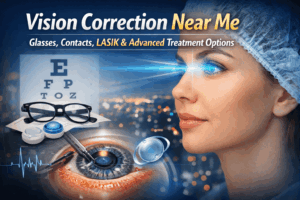
When it comes to vision correction, most individuals are acquainted with the traditional choices of contact lenses and glasses. While these approaches have been extensively utilised for decades, there are now various alternate methods that can offer enhanced visual acuity and convenience. Irrespective of the vision correction technique you’re considering, it’s vital to consult with an experienced eye doctor. These eye care experts can meticulously evaluate your vision and general eye health, and offer adapted recommendations on the superlative course of action.
While contact lenses and eyeglasses can assist you in achieving better vision, they cannot offer you perfect vision. Though, advanced technologies at Tosee2020 now make improved vision attainable. Our team of optometrists near you are available to tell you about cutting-edge vision correction choices that can considerably progress your vision and quality of life.
Common Vision Problems Treated:
If routine testing designates that you have a refractive error, conventional treatment calls for wearing contact lenses or corrective glasses. Over 150 million people in the US wear corrective lenses. In many cases, surgical correction of refractive errors is possible using modern surgical techniques such as LASIK.
Conventional treatment for disorders such as nearsightedness, farsightedness, and astigmatism typically relies on corrective prescription lenses. Disorders such as cataracts, glaucoma, macular degeneration, and retinal detachment require advanced medical and surgical treatments. Enormous progress in eye surgery has been made over the past few decades. Many people with eye problems previously felt to be untreatable now enjoy improved eyesight and an improved quality of life. This applies to individuals of every age — infants to senior citizens!
TO TREAT NEARSIGHTEDNESS, your eye doctor will usually prescribe lenses to focus visual images correctly on the retina. Depending on the specifics of your eye exam, you may have a choice between wearing conventional eyeglasses and contact lenses.
As an alternative to corrective lenses, surgery can sometimes be performed to treat nearsightedness. Excimer laser treatment (like LASIK) uses a laser beam to remove microscopic amounts of tissue from the cornea. This effectively flattens or steepens the cornea as needed so that light rays focus correctly on the retina. LASIK is safe and effective for most patients with nearsightedness, but only up to a certain level. Some patients with thin corneas, extreme nearsightedness, or significant dry eye may be better served with a variant of LASIK called PRK or they may not be good laser candidates at all. There are advanced options for these patients, including surgical correction with implantable contact lenses.
TO TREAT FARSIGHTEDNESS that does not resolve itself naturally, glasses or contact lenses can be prescribed. People typically seek treatment for farsightedness when they begin to complain of eyestrain, especially at the end of the day, or when they have trouble focusing while reading. LASIK can also be used to treat lower levels of farsightedness. Higher levels of farsightedness can only be surgically corrected with a refractive lens exchange — the natural lens is replaced with an intraocular lens that is more powerful, thereby focusing the light on the retina.
TO TREAT ASTIGMATISM, the accepted prescription is a lens that will correct or neutralize the effect of the uneven cornea. Again, you will typically have a choice between glasses and contact lenses. Surgery for astigmatism can include limbal relaxing incisions, LASIK, and Toric intraocular lenses.
WITH CATARACTS, the eye’s natural lens becomes cloudy, obscuring vision. Correcting the problem was once a complex procedure requiring general anaesthesia and a week of hospitalization. Today, a process called “phacoemulsification” uses ultrasound to break up the cataract and remove the tiny lens fragments through an incision so small that it usually requires no stitches. Some people mistakenly call this laser cataract surgery. The surgeon then inserts an artificial lens implant. Local anaesthesia is used and the patient goes home from an outpatient facility typically within an hour or two after surgery.
FOR MACULAR DEGENERATION, there is currently no cure for age-related macular degeneration (AMD), but new treatments are sometimes able to prevent severe visual loss.
Nearsightedness & Farsightedness:
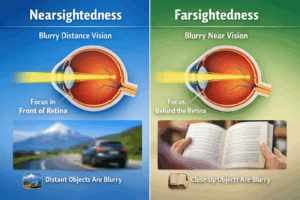
For vision to work properly, both your distance and near vision should be clear. Both nearsightedness and farsightedness are refractive conditions, referring to how light is focused in relation to the eye. Below, learn what farsightedness and nearsightedness mean, as well as the differences between the two.
Farsightedness:
The technical term for farsightedness is hyperopia. If you are farsighted, you can see distant objects well, but reading or looking at items close up is blurry for you. With hyperopia, the eyeball is either too short or there is not enough curvature of the lens for objects to focus properly. Light will focus at a point beyond the retina instead of in front of the retina or directly on its surface. This causes blurry vision up close.
Nearsightedness:
Nearsightedness, also known as myopia, is the opposite of farsightedness. It means that with your uncorrected natural vision, you have difficulty seeing at a distance. This happens when the eyeball is too long. Because it is longer than normal, light cannot focus properly through the lens and cornea. When you view an object, the light rays that hit your eye will end up focusing at a point in front of the retina instead of focusing directly at the retina. This is why objects farther away become blurrier compared to objects up close – the focusing distance is further. Nearsightedness can also be caused by the curvature of the lens of the eye. If the lens is too curved, this will throw off your focusing point as well.
Differences Between Nearsightedness & Farsightedness:
Being farsighted or nearsighted both affect your ability to see clearly. The difference between farsighted and nearsighted is whether you have difficulty seeing up close or at a distance. Farsightedness makes it hard to see things that are close, and nearsightedness makes it difficult to see things that are far away. Both conditions can be improved with corrective lenses such as glasses or contacts as well as LASIK surgery.
Presbyopia Solutions:
Presbyopia can be treated a number of ways, including:
- Glasses: You may choose to wear prescription or over-the-counter glasses just for reading or close-up work, or you may choose:
- Bifocals: The lower part of the lens magnifies objects and writing for better close-up vision
- Trifocals: The lower part of the lens has two magnifying powers: one for close-up work and one for mid-range work, such as on a computer
- Progressive Lenses: The correction ranges from close to midrange to far without any visible lines
- Contact Lenses: Both soft and gas permeable lenses can correct for presbyopia. Options include:
- Monovision Lenses: Features one lens for close-up work and the other lens for distance vision
- Modified Monovision Lenses: Combine a traditional contact lens for distance in one eye with a contact lens that features a bifocal for reading in the other eye
- Surgery: Surgery to correct close-up vision in your non-dominant eye include:
- Laser Vision Correction (LASIK): Using a laser to correct the shape of the cornea
- Implanted Lens: A synthetic corrective lens used to surgically replace the aging lens
- Corneal Ring Implant: A ring inserted in the eye to correct the curve of the cornea for better close-up vision
Contact Tosee2020 Today To Discover Cutting-Edge Vision Correction Choices That Can Considerably Progress Your Vision And Quality Of Life.